Which result are you waiting for?
A completed page, a crawler visit, a citation and a new customer are four different milestones. An agency can schedule an approved edit. It cannot schedule an independent system’s decision to use that page or a buyer’s decision to contact you. Ask which milestone a proposed timeline actually describes.
Google states that requesting a recrawl does not guarantee inclusion; crawling can take days to weeks. That describes Google crawling, not a timetable for ChatGPT citations or leads. There is no sound conversion from that interval into a universal GEO deadline.
| Milestone | Evidence | What it does not establish |
|---|---|---|
| Work delivered | Approved change, URL, date and acceptance check | That a search system has processed the change |
| Discovery observed | Verified crawl evidence or an available index inspection | That the page will be cited |
| Citation observed | Saved answer with the exact linked URL and test conditions | Stable visibility or a new customer |
| Inquiry accepted | Confirmed delivery and a separate qualification check | That every untracked inquiry came from AI |
Before day 1: save a baseline you can compare
Start the review calendar when the scope and baseline are agreed. Record the implementation date for each change separately: a page approved on day 28 has not had the same observation window as one changed on day 2. If implementation is delayed, say so rather than calling the whole period a test of completed work.
Choose buying questions for one defined service, market and language. Save the exact prompt, platform, product or mode, date, answer and citation URLs. Agree a repeat rule and retain unfavourable answers. Treat a changed question set as a new sample, or report the unchanged subset separately.
For existing pages, save the current content and available measurement. For a new URL, record “not previously published”; do not invent a zero-visibility history. Missing analytics or Search Console access is a measurement gap, not evidence of no demand.
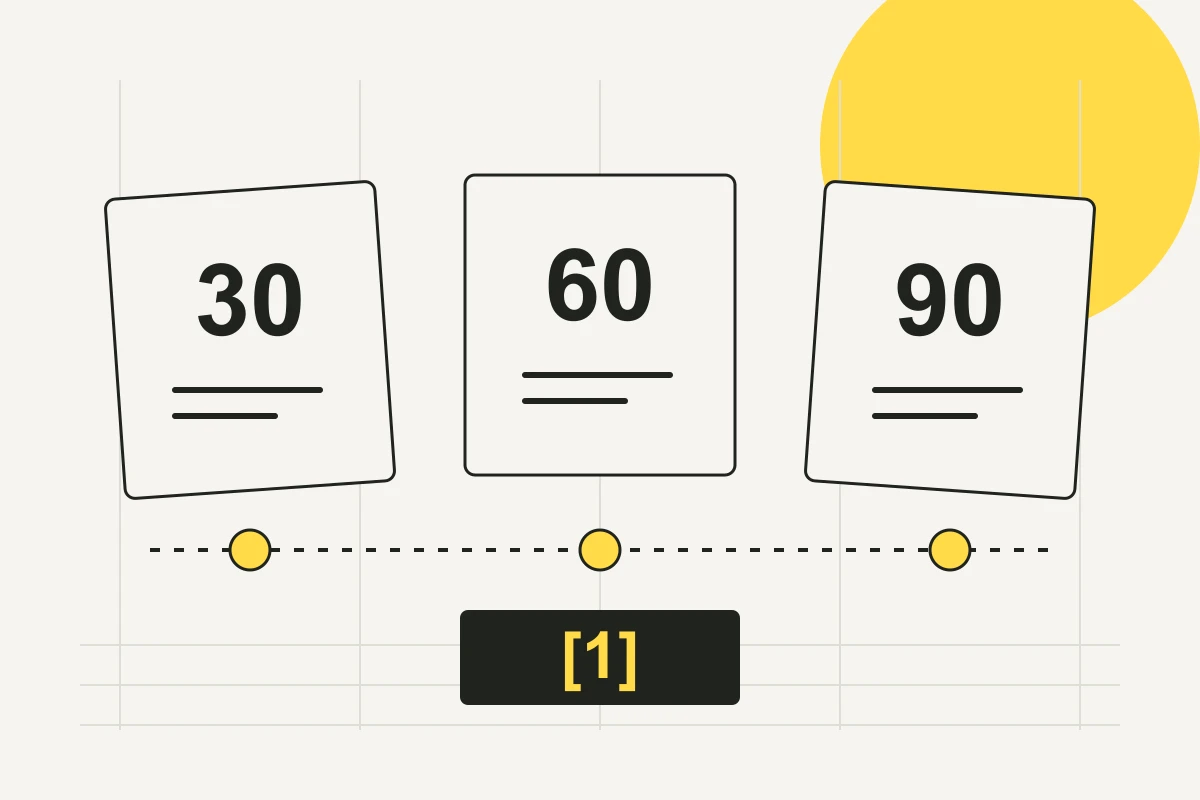
A 30/60/90-day evidence calendar
Copy this calendar into your project brief. The dates are our suggested review rhythm; adjust them to the scope, approval cycle and available evidence. The decision column matters more than reaching a date.
| Checkpoint | Evidence to bring | Decision |
|---|---|---|
| Day 0: baseline | Priority questions, saved answers, page state, inquiry definition, owners | Agree what will change and how it will be checked |
| Day 30: delivery and access | Change log, approved pages, access checks, open blockers, available discovery evidence | Accept completed work; assign unresolved implementation or access tasks |
| Day 60: repeat observations | Comparable answers and citation URLs, unchanged sample, referral data where available | Investigate missing evidence; continue or narrow the next work package |
| Day 90: business review | Delivery record, repeated observations, accepted inquiries, qualification and total cost | Continue, change scope or pause with an explicit reason and next review date |
- 01Save the baseline
- 02Verify delivery
- 03Repeat observations
- 04Decide the next scope
At 30 days: check implementation before judging visibility
Ask for the agreed tasks with their actual completion dates and acceptance evidence. Can a visitor read the important service information? Do the links reach the intended page? Are public pages accessible to the relevant search crawler? An unresolved access problem is a task to fix, not a reason to buy more content automatically.
Check the right crawler controls: OpenAI distinguishes OAI-SearchBot for search from GPTBot for training. A training permission is not a substitute for search access. Use verified request evidence where available; typing a crawler’s name into a browser user agent does not prove the real crawler was admitted.
A working implementation is useful progress even without a citation. Report it as delivered work and keep the visibility result open. If the work is unfinished, agree an owner and a revised delivery date instead of moving the citation target.
At 60 days: repeat the same test and inspect the sources
Compare like with like. Separate platforms, markets and languages; keep search-enabled answers apart from other modes. Record mentions and linked citations separately. Show the number of saved answers behind any proportion, and report missing runs rather than silently removing them.
One first citation establishes an observation at a particular time. Repeat it before describing a pattern. If a competitor appears, inspect the cited page: does it answer a different need, offer stronger evidence or describe a different service? Treat that as a hypothesis to investigate, not proof of a hidden ranking factor.
Use the pattern to choose one manageable next change. If all priority pages remain inaccessible, solve access. If answers use an outdated public description, trace its source. If there are useful visits but no inquiries, check the offer and contact path before concluding that more citations will solve the problem.
At 90 days: make a business decision
Review what was delivered, what changed in repeated observations and what the business received. Separate attributed visits, accepted inquiries and qualified opportunities. A form-button click is not confirmed delivery; an accepted inquiry can still be irrelevant to the service.
Continue when there is a clear next task, sufficient evidence to justify it and an affordable scope. Narrow the programme when one bottleneck dominates. Pause when the measurement cannot support a decision, approvals prevent implementation or the expected business value no longer justifies the cost. Set a specific next review condition instead of extending the same promise.
No citation by day 90 does not establish that GEO can never help. Equally, one citation does not establish that the programme paid for itself. The question is whether the evidence supports the next investment.
What changes the schedule?
An established, accessible site with clear service pages starts with different work from a new site with missing content. Approval delays and developer capacity affect delivery. Discovery and source selection belong to external systems. Third-party editorial decisions, relevant competition and your buyers’ decision cycle add separate dependencies.
Google describes its AI search features as using Search foundations and says inclusion is not guaranteed. That is a reason to resolve documented gaps, not to attach a fixed citation date to a technical checklist.
Do not infer a cause from timing alone. Illustrative example: a service page changes, a trade publication mentions the business, and a citation appears later. The sequence does not isolate which change mattered. Save each date and keep the causal claim limited.
An open review log for your next meeting
Copy these fields into a document or spreadsheet. Keep evidence links in your own project workspace and exclude customer personal data from shared reports. Use “not available” where the evidence is missing.
| Field | What to record |
|---|---|
| Scope and observation window | Service, market, language, baseline date, implementation date, review date |
| Delivery | Task, owner, acceptance check, completed date or blocker |
| Visibility | Exact prompt, platform/mode, repeats, full answers, mention and citation URLs |
| Business outcome | Attributed visits if available, accepted inquiries, qualification rule, cost |
| Decision | Continue / change / pause; evidence, owner and next review condition |
Agree evidence and ownership before buying a timeline
Request a baseline, dated deliverables, a repeatable test and a review decision. Ask who implements each change and who approves it. A promise of “results in three months” is incomplete until the provider defines the result and its evidence.
BeeCited can help connect website work, content, brand information and measurement within an agreed GEO scope. Bring your priority service and existing observations to the inquiry; we can use them to discuss the first work package and its acceptance checks.
Sources & further reading
BeeCited’s proposed review framework, written by a GEO service provider. It is not a measured client timeline or an industry benchmark. Primary platform guidance was checked on 16 October 2026; examples are illustrative and no client results are claimed.